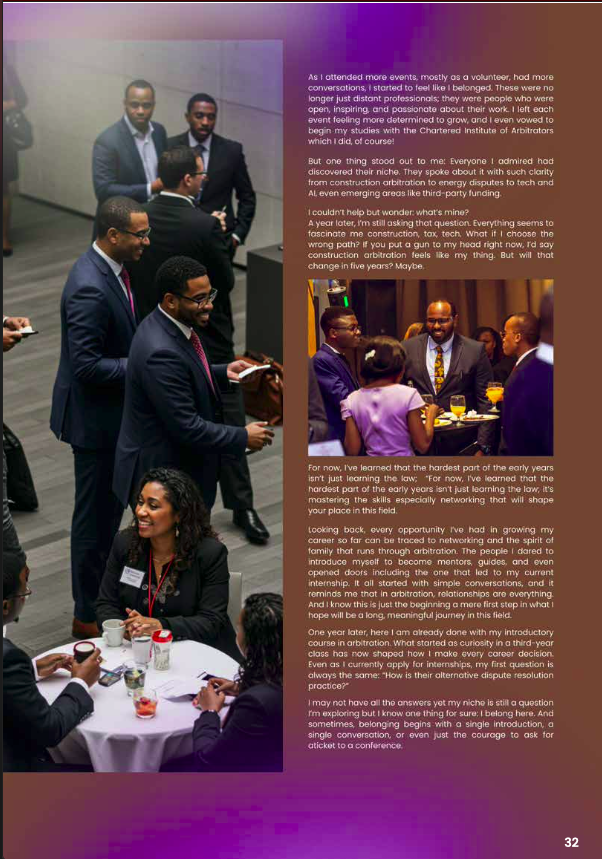
One of the most surprising things about entering arbitration spaces for the first time is realising how much professional growth happens outside formal classrooms.
Before attending conferences, volunteering at ADR events and engaging with practitioners, arbitration felt distant to me. It was something I associated with experienced advocates, large commercial disputes and highly specialised legal practice. From the outside, it seemed like a field that required years of experience before one could even participate meaningfully.
What changed my perspective was exposure.
The first time I attended an arbitration-related event, I remember feeling out of place. Many people already knew each other. Conversations flowed naturally between practitioners, arbitrators, academics and students who appeared confident and established within the field.
For a moment, it felt easier to remain quiet and simply observe.
Instead, I introduced myself.
That single decision taught me something important about professional growth: opportunities in law are often built through presence, conversation and willingness to participate, even before feeling completely ready.
Exposure Creates Understanding
One of the biggest advantages of professional exposure is that it transforms abstract legal concepts into real professional experiences.
Reading about arbitration in class is valuable, but attending conferences, listening to practitioners and observing discussions around disputes makes the field feel more practical and human.
Exposure helps young professionals understand:
- How practitioners think through disputes
- How arbitrators approach decision-making
- How professional relationships are built
- How commercial realities influence legal processes
- How communication shapes professional credibility
These lessons are difficult to fully understand through textbooks alone.
Learning Beyond Formal Roles
One thing I have come to appreciate is that professional growth does not always begin with major titles or positions.
Sometimes growth begins through:
- Volunteering at events
- Taking notes during panel discussions
- Asking thoughtful questions
- Introducing yourself to practitioners
- Following up after conversations
- Listening carefully to experienced professionals
These moments may appear small, but they gradually build confidence, visibility and professional understanding.
In many ways, exposure teaches professional etiquette as much as legal knowledge.
The Importance of Professional Networks
Legal practice is built around people as much as law.
Conversations with practitioners often reveal perspectives that are not easily found in formal academic material. Hearing professionals discuss challenges, career paths and practical experiences provides insight into how legal work functions beyond theory.
Networking also helps young professionals realise that growth within the legal profession is usually gradual. Many experienced practitioners began with uncertainty, observation and learning before eventually becoming leaders within their fields.
Understanding this makes professional spaces feel more accessible.
Arbitration as a Growing Interest
My interest in arbitration continues to grow because the field combines several things I find particularly engaging:
- Structured problem solving
- Commercial reasoning
- Professional communication
- Negotiation
- Technical legal analysis
- Practical dispute resolution
I also appreciate that arbitration often encourages efficiency, confidentiality and flexibility in resolving disputes.
The more exposure I gain, the more I understand how broad the field truly is and how important continuous learning becomes within ADR practice.
Why Visibility Matters
One important lesson I continue learning is that visibility matters.
Not visibility in the sense of self-promotion alone, but visibility through participation, consistency and professional engagement.
Attending events, writing reflections, engaging in conversations and remaining curious creates opportunities for growth over time.
Professional development rarely happens instantly. Often, it develops quietly through repeated exposure to the right environments and people.
Growth Through Discomfort
Many professional experiences begin with discomfort.
Walking into unfamiliar rooms, speaking to experienced practitioners and navigating professional spaces can feel intimidating at first. However, discomfort often becomes part of growth.
Some of the most valuable experiences I have had in ADR spaces began with uncertainty:
- Unsure whether I belonged in the room
- Unsure whether I knew enough
- Unsure whether conversations would lead anywhere meaningful
Yet each interaction gradually built confidence and perspective.
Exposure does not eliminate uncertainty immediately, but it helps transform uncertainty into experience.
Conclusion
Professional growth within arbitration and ADR is not shaped only by formal study. It is also shaped by exposure, relationships, observation and participation.
For me, entering ADR spaces has been less about arriving as an expert and more about learning consistently, remaining curious and being willing to engage with opportunities as they come.
Sometimes growth begins with something very simple:
introducing yourself, starting a conversation and choosing to participate even before feeling fully ready.
Disclaimer: This article reflects personal professional experiences and general observations. It is intended for informational and reflective purposes only and does not constitute legal advice.